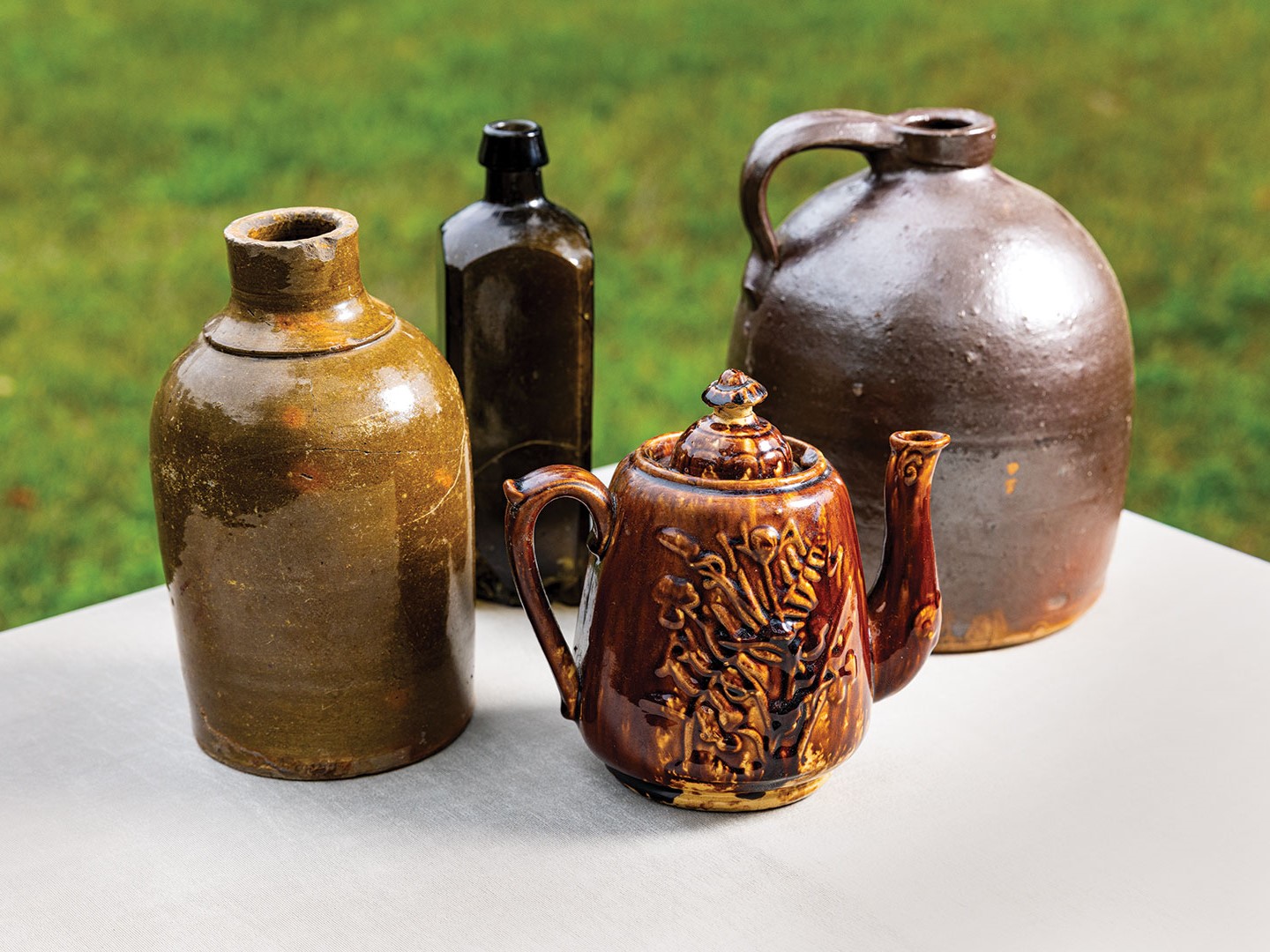
Pioneer Archeology finds (from left to right) include a Galena Illinois Pottery storage vessel (c. 1850) a bitters bottle (c. 1855), a Rockingham tea pot (c. 1860) and a 2 gallon jug with Albany slip brown glaze found (c. 1855). Photos: Chris Emeott
Pioneer Archeology digs up artifacts in backyards across the St. Croix Valley.
Hastings archeologist Brandon Lewanski says most people are shocked by how much history rests beneath the grass in their own backyards. When he approached one 83-year-old Hastings resident, Lewanski says, “She thought we were nuts when we told her that we’re going to find a ton of stuff in her yard.” The woman had lived there since 1962.
But with the homeowner’s permission, the artifacts Lewanski unearthed painted a vivid picture of the property’s original owner. Among the discoveries were about 20 teapots and a complete absence of beer or other liquor bottles. To Lewanski, that suggested the homeowner had likely been a teetotaler at one point.
Lewanski did a different kind of digging and, through the home’s original deed, discovered it first belonged to Hastings founding father, Harvey Gillitt. Gillitt owned multiple businesses downtown and the steamboat Adelia, though Lewanski says, “He lived very humbly for somebody that was of his stature.”
The current homeowner was stunned.
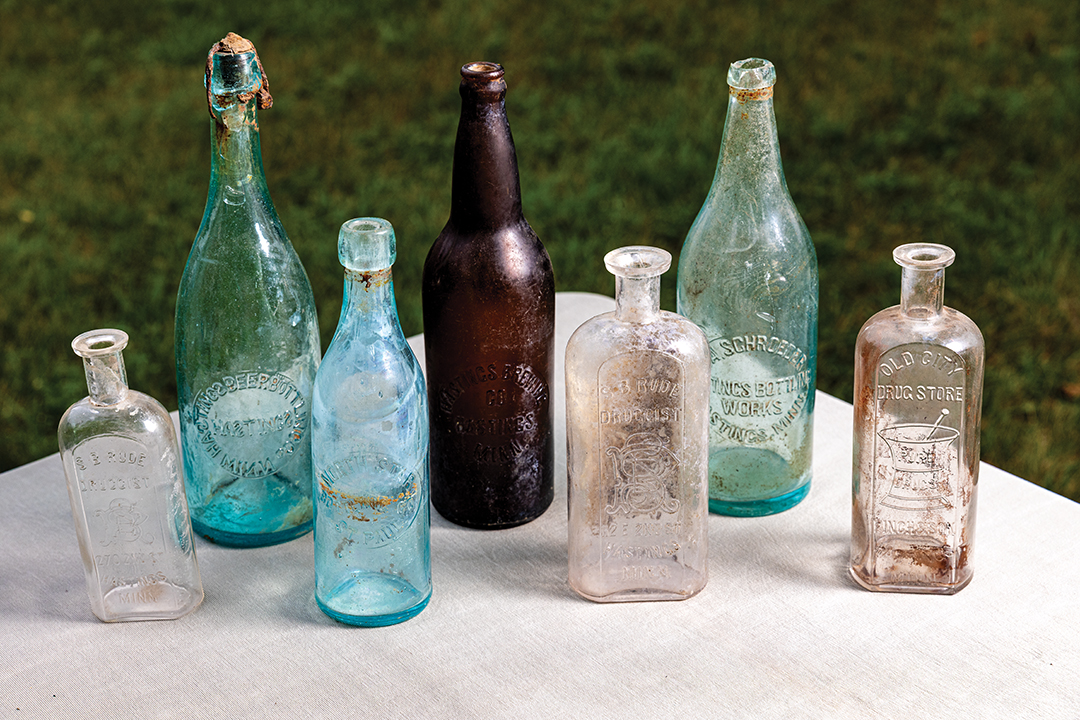
Many of the bottles found by Pioneer Archeology include embossed markings or maker’s marks that reveal the object’s age and use.
This is exactly the kind of hidden history Lewanski uncovers through Pioneer Archeology, an operation dedicated to preserving local history “one piece at a time.”
Lewanski, an auto technician by trade, traces his fascination with archeology back to his father, Jim Lewanski, who worked in construction and regularly unearthed bottles and other artifacts on job sites. His father would bring items home, and eventually, the two began going on digs of their own together. “We’ve been doing it for over 30 years,” Lewanski says.
Though Pioneer Archeology, founded in 2014, is not a family business, Lewanski’s father still occasionally joins digs. Lewanski also works alongside Peter Whitaker, a detectorist who uses a metal detector to help identify where items are buried. “We kind of have a harmonious team … he metal detects, and I dig for the other stuff,” Lewanski says.
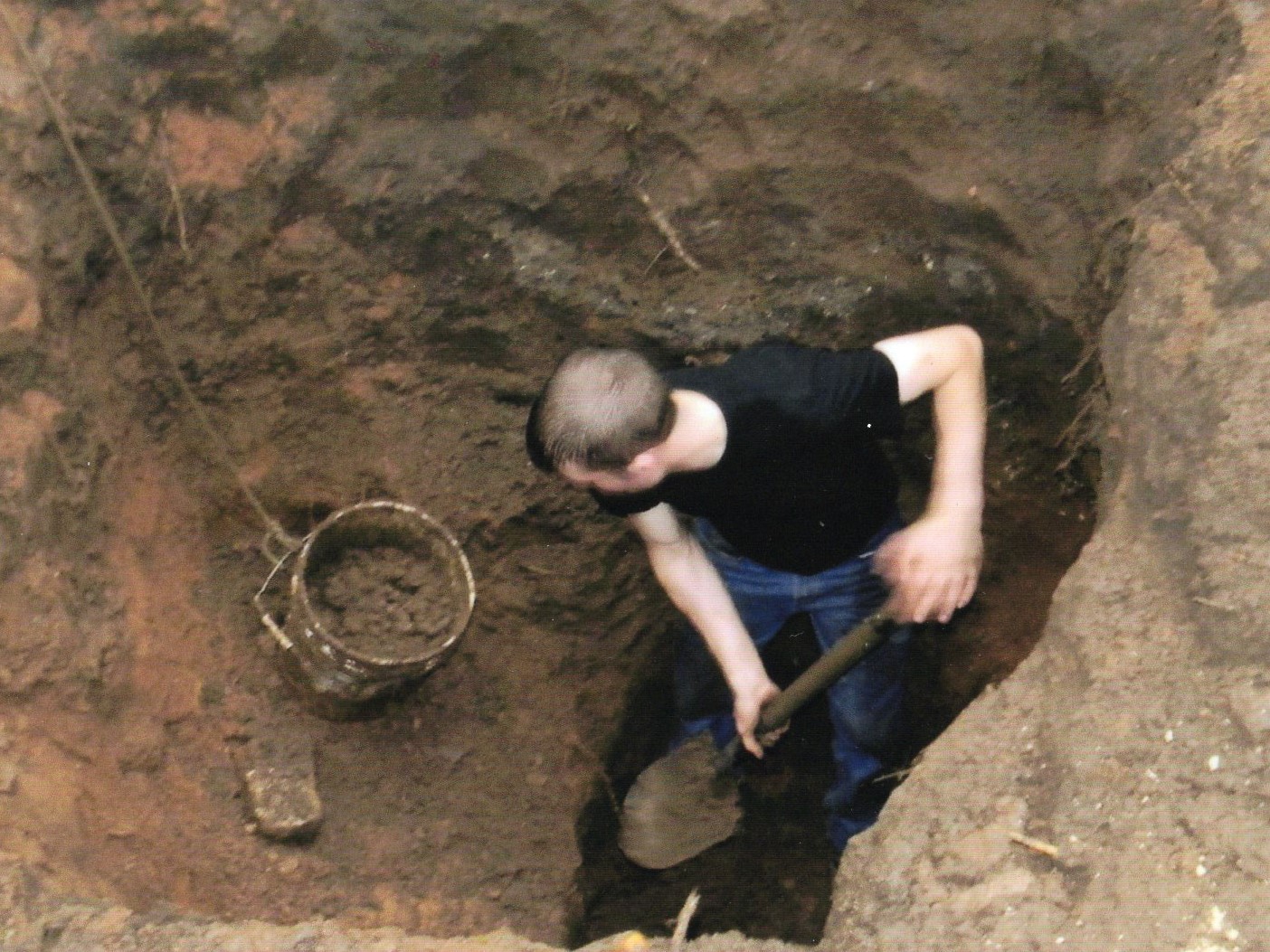
Pioneer Archeology specializes in privy digs. In the past, privies, or outhouses, were also used as a household’s trash pit, which often makes them treasure troves for historic artifacts. Photo: Pioneer Archeology
Pioneer Archeology excavates a wide variety of sites, including old dumps and roadbeds, but privy digging is Lewanski’s specialty. “A privy is an outhouse,” he says. “Everybody had outhouses back in the day before they had indoor plumbing.” But the structures weren’t only used as bathrooms. Lewanski says families also treated them as trash pits.
Once an outhouse was filled, families would dig a new hole a few feet away and start over. Lewanski says that, when excavating a backyard, he can often trace how a household changed over time. “You can tell if they had kids right away or if they were elderly or sick,” he says. “You can really get a big picture as to what was happening in the household.”
When scouting potential dig sites, Lewanski often looks first at the architecture. “I kind of know the date of the house just by looking at [it],” he says. Greek Revival homes and other historic designs provide clues about a property’s age; the older the house, the more likely it dates back to a time when privies were commonplace.
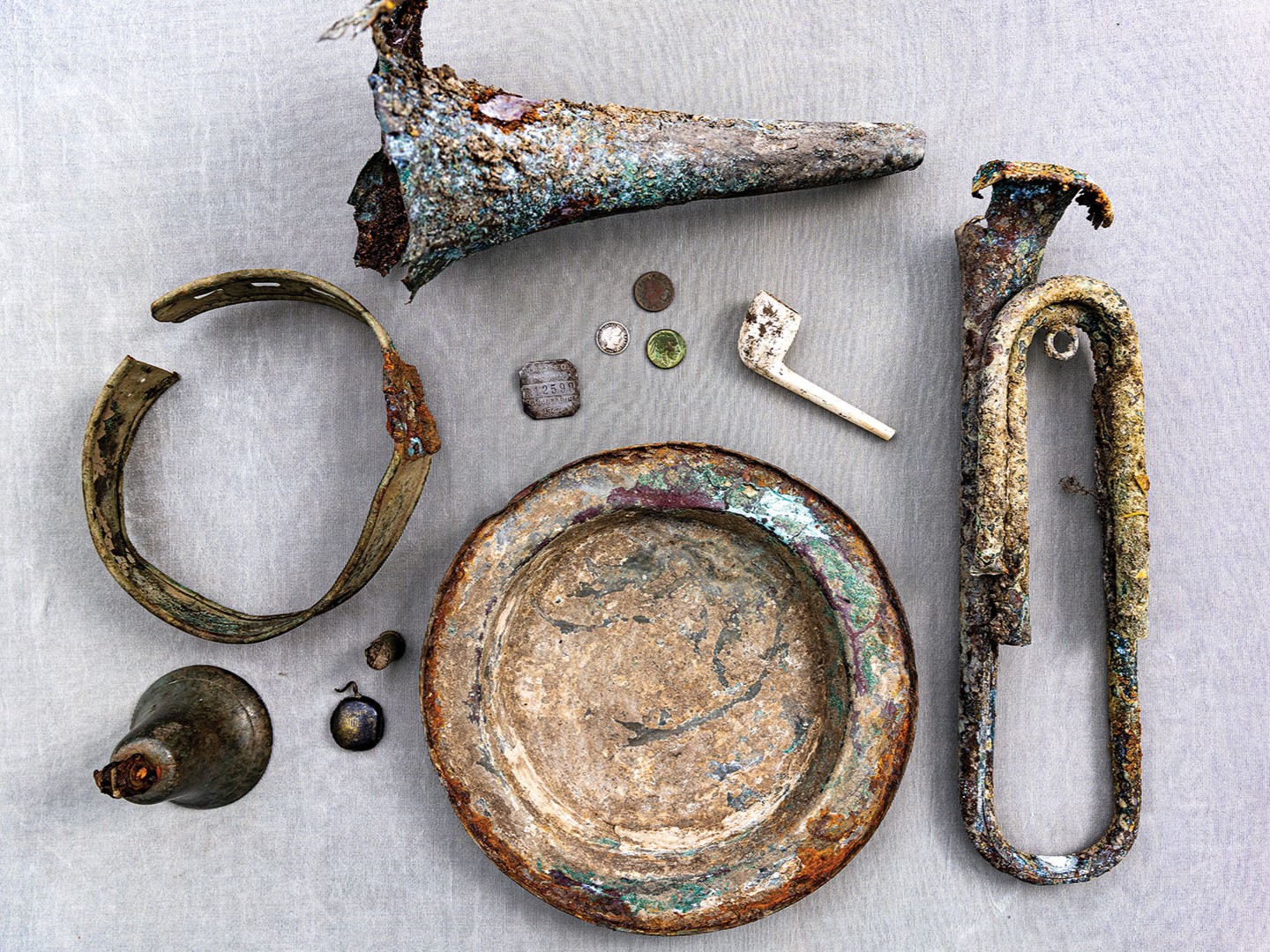
Metal detecting allows the Pioneer Archeology team to discover a wide variety of historic artifacts, including (pictured) bugels, a Civil War-issued plate, a clay penny pipe and a pipe windcap dating to the late 1700s. Photos: Chris Emeott
As Lewanski’s work has gained traction, many property owners have asked him to dig on their land. Other times, Lewanski simply knocks on the front door of promising properties to ask for permission. He says he never excavates a property without approval, private or otherwise. The digs are at no cost to homeowners, and ownership of found artifacts is negotiated on a case-by-case basis.
Pioneer Archeology’s debut was a privy dig at an old schoolhouse in Afton during the annual Afton Strawberry Festival. It quickly turned into a community event, with 500 people turning out to watch. “We dug almost no ink bottles … which is strange for a schoolhouse,” Lewanski says. Instead, they found crockery, beer bottles, whiskey bottles and snuff jars. Children from the crowd even helped to wash off artifacts as they were pulled from the ground.
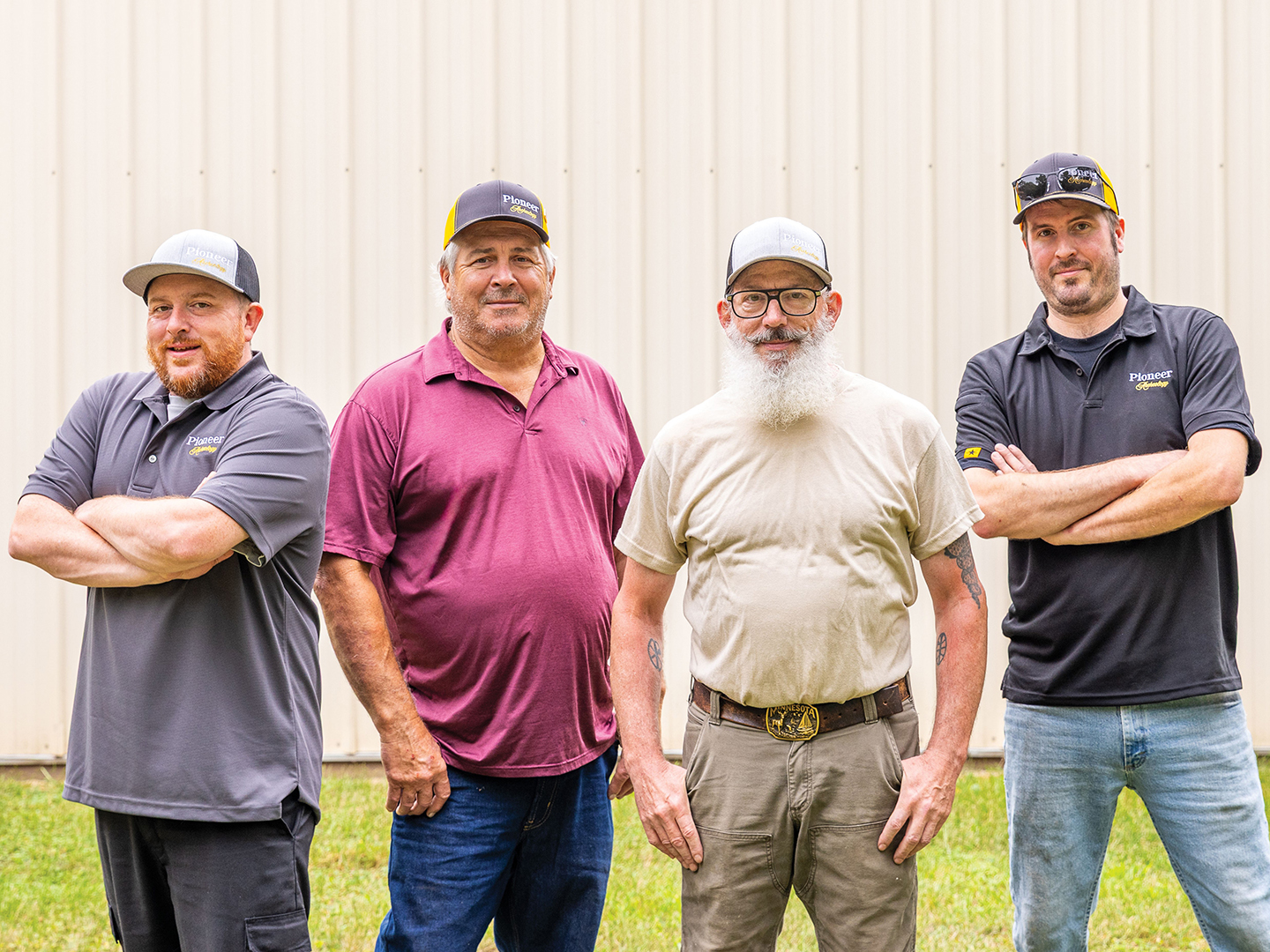
From left to right, Austin Alle, Jim Lewanski, Peter Whitaker and Brandon Lewanski.
A pocketwatch recovered from a roadbed in Point Douglas stands out as one of Pioneer Archeology’s more notable finds. The group was granted permission to excavate sections along Military Road, originally built in the 1850s, during reconstruction work in 1995. “It was in this little case,” Lewanski says. “We opened it up, and the thing crumbled. It had a pure silver backing on it with the picture of a Quaker. There was still a little card in there, and it was all in German.” Lewanski believes the watch likely belonged to a German immigrant involved in building the road. “He probably brought that back from his home country,” he says.
Many of the artifacts Lewanski unearths eventually make their way back to the people who live above them. “They’re completely blown away by it,” he says. Other items have been donated to local historical organizations and exhibits, including the Afton Historical Museum and the Pioneer Room at Hastings City Hall.
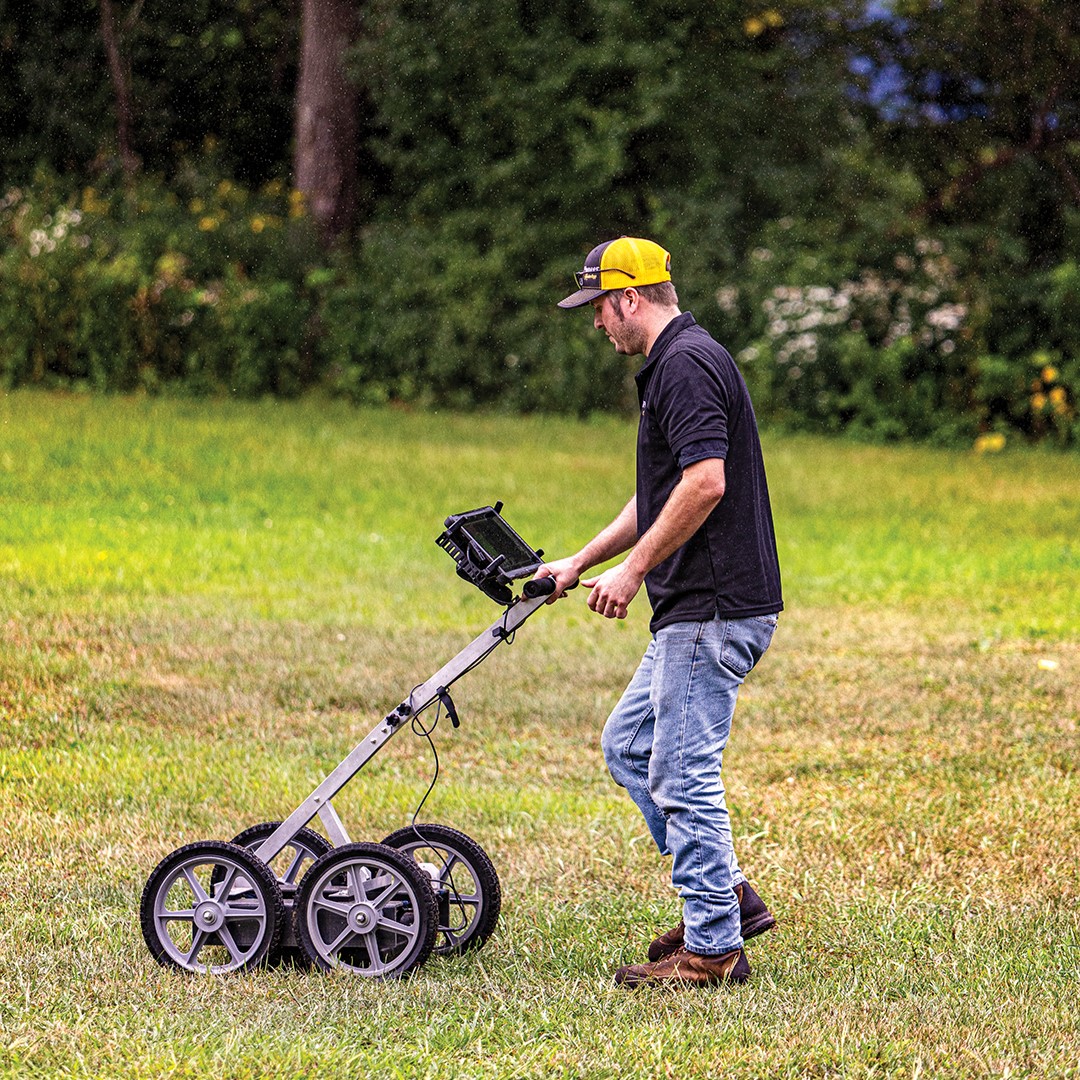
Brandon Lewanski uses a ground-penetrating radar (GPR) system by Easy Radar U.S.A. to locate potential dig sites through non-destructive radio waves.
Pioneer Archeology has no shortage of future projects. Lewanski says he hopes to dig in Bayport; Prescott, Wisconsin; and a schoolhouse outside of River Falls, Wisconsin, which shares an owner with the Afton schoolhouse. He would also like to organize more community digs like the one at Afton, where people gathered around to watch history being unearthed in real time. “I’m kind of pioneering a new way of archeology that’s more community interactive and … friendly for people that want to learn about history,” he says.
Pioneer Archeology
Facebook: Pioneer Archeology