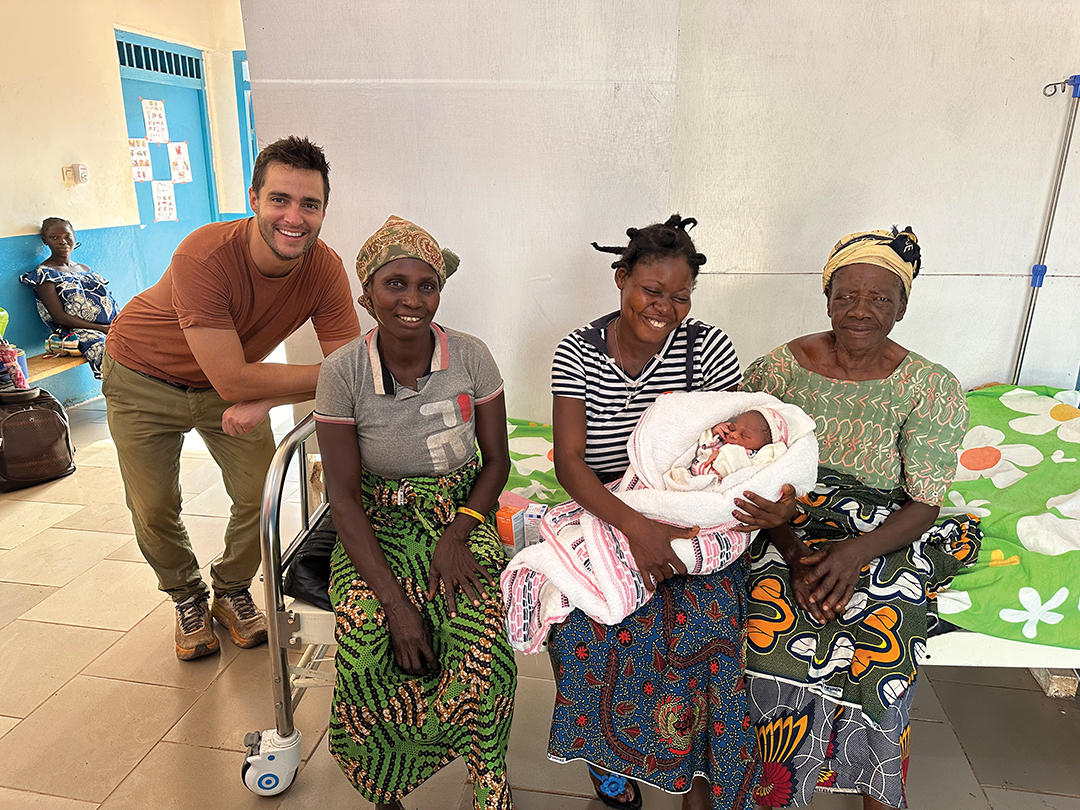
Ted Hooley stands with four generations of women from the same family. The newest addition was the first to be born in a clinic. Photos: Senitizo
Ted Hooley’s humanitarian nonprofit brings care and healing to rural communities.
Ted Hooley, a Stillwater native and the founder of humanitarian nonprofit Senitizo, grew up in a community that fostered generosity and service. “It was kind of like the ideal childhood,” Hooley says. His cousin, Erin Zauner, agrees. “We have very strong ties to the St. Croix Valley, and if you grew up here, you know how tight-knit the community is,” Zauner says. “Watching the example of our grandparents, parents, and aunts and uncles gave [him] a strong foundation for wanting to help people.”
Hooley’s path to humanitarian work started when he was a teenager at Stillwater Area High School. His time at Saint John’s University in Collegeville deepened that interest. “I ended up studying economics and Hispanic studies,” Hooley says. “I did a summer in Kenya [in 2009], and that was when I really had this moment of realizing I didn’t know anything about the world.”
After graduate school and working in global health and humanitarian aid—including two years responding to the Ebola crisis in Liberia and Sierra Leone—Hooley realized he wanted to work where he could see direct impact. “Having that direct contact with the people that I’m working with is really essential for me,” he says. So in 2017, Hooley launched Senitizo, a nonprofit focused on health care in the Central African Republic (CAR), one of the world’s poorest and most fragile countries. “I wanted to start a locally based organization in one of these places but particularly in a place where it was extremely challenging … and where you could try a lot of new things,” he says.
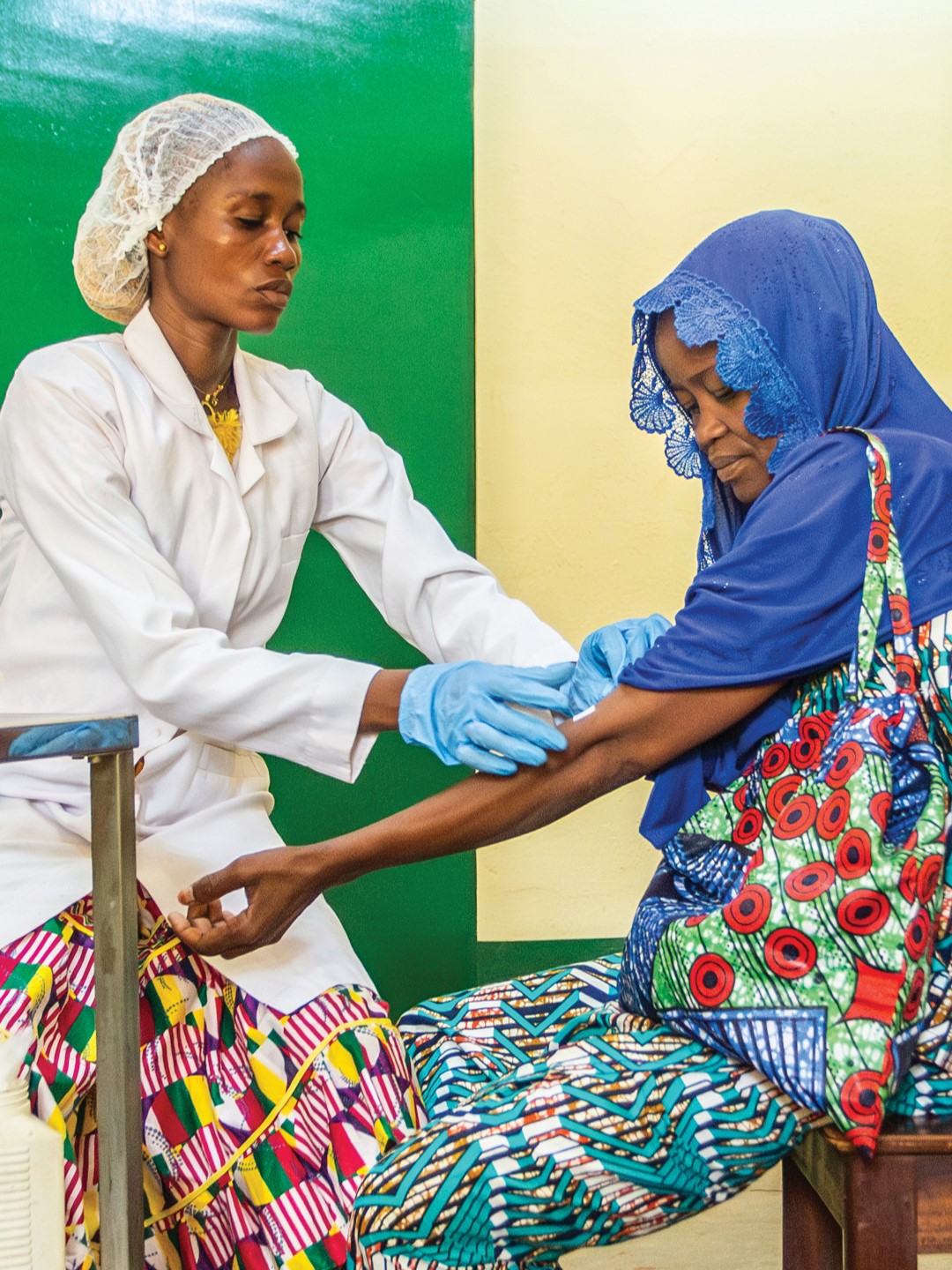
Routine testing for HIV viral load for a patient in anti-retroviral treatment at a Senitizo clinic in Bangui, Central African Republic.
Despite ongoing civil conflict, Hooley found CAR to be relatively low risk for humanitarian workers and fell in love with the people and their joy amid hardship. He now lives almost full time in CAR but returns to the United States often to visit his family and friends.
A main focus of Senitizo is maternal and child health, where the needs are urgent. Hooley says, “Thirteen percent of kids in CAR die before they reach age 5, and one out of every 100 women dies during childbirth.” Senitizo’s north star is keeping families together and making sure parents and children survive and lead healthy lives, so they can continue to participate in their communities. A key part of Senitizo’s model is empowering local staff. “We hire all Central Africans,” Hooley says. “The real wealth of the country is in the people.” The nonprofit builds health networks to bring care closer to remote villages, where patients often walk 15 to 20 miles for treatment.
Even when he’s far from home, Hooley stays connected. “All my high school friends are still in Stillwater,” he says. “It makes a big difference to have that base.” Many local organizations, including the Stillwater Rotary Club, have donated funds for infrastructure and equipment to Senitizo. “So many local people have been key supports from the very start.”